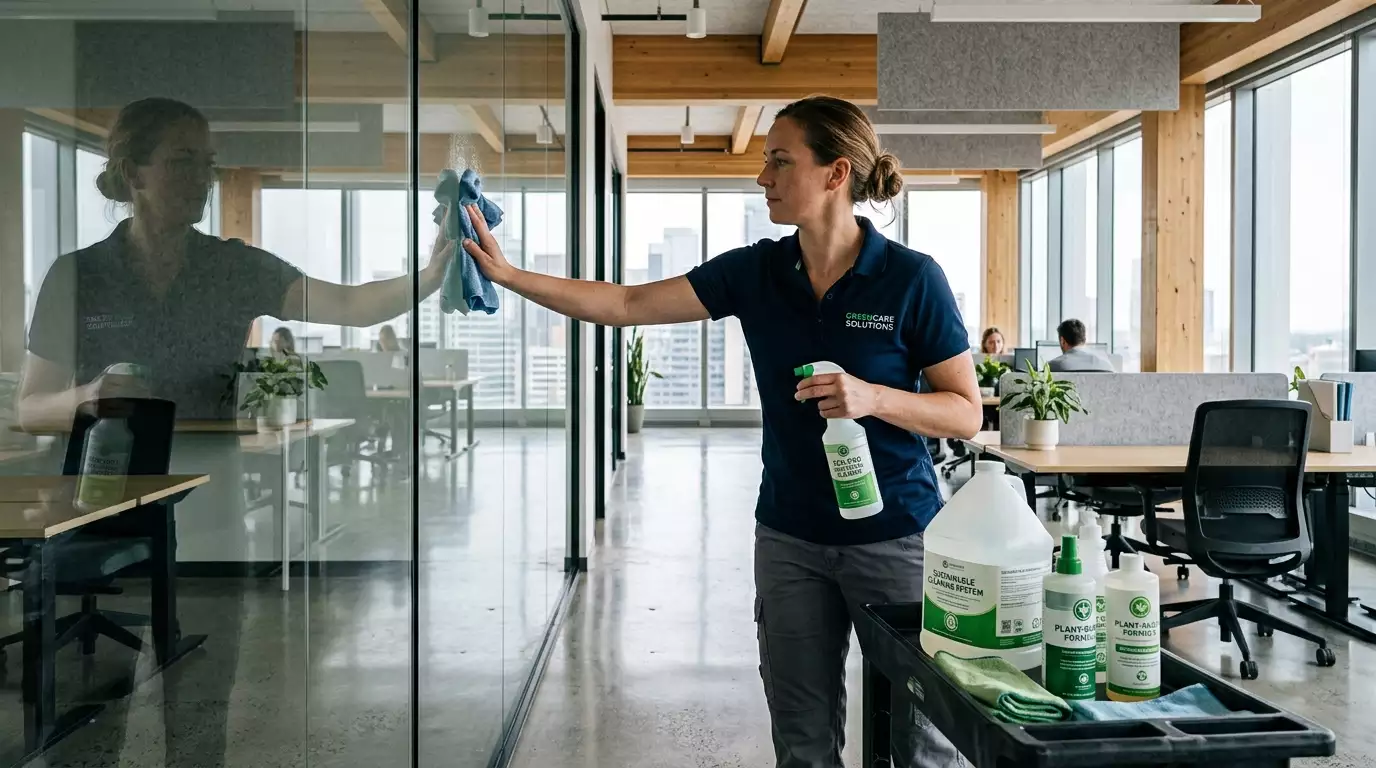
Eco-Friendly Commercial Cleaning for Healthier Workplaces
Green Seal and EPA Safer Choice certified cleaning programs that protect your employees' health, satisfy your ESG commitments, and support LEED certification–without sacrificing cleaning performance.
Your Building Smells Like Cleaning Chemicals. Your Employees Are Breathing Them All Day.
The Problem Nobody Connects Until Someone Names It
Thursday morning. You walk into the office and it hits you immediately – that sharp bleach-and-ammonia smell from last night’s cleaning crew. You’ve stopped really noticing it. Your employees have too.
But their bodies haven’t.
VOCs – volatile organic compounds – are the chemical byproducts off-gassed by conventional cleaning products after application. In a sealed Northwest Suburbs office building with windows closed from November through April and HVAC recirculating the same indoor air all day, those VOCs distribute to every desk, meeting room, and workspace. The concentration builds throughout the day.
The symptoms show up as: persistent afternoon headaches, eye and throat irritation, mental fog after lunch, fatigue that employees blame on the workload but that improves markedly on work-from-home days. Most people never connect their Thursday afternoon headache to Wednesday night’s cleaning.
There’s a business case for eco-friendly cleaning that has nothing to do with sustainability branding. It’s about the daily health and performance of the people who spend 40+ hours a week in your facility – and whether your cleaning program is quietly making them feel worse.
What “Green Cleaning” Actually Means (And What It Doesn’t)
The phrase has been so thoroughly co-opted by marketing that it’s lost meaning. Every cleaning company in the NW suburbs claims to offer “green options.” Most of what gets sold under that label is greenwashing – retail-grade products with no certified efficacy, “natural” ingredients that don’t perform, or conventional products with a leaf logo on the label.
That’s not what we use. And it’s why most facility managers who’ve tried “green cleaning” before are skeptical – they tried the wrong product category.
Green Seal certification requires independent third-party testing against ASTM and AOAC performance standards for cleaning efficacy. A product can’t be Green Seal certified by claiming it’s made with plants. It has to prove it cleans.
EPA Safer Choice certification requires that every ingredient in the formulation meet strict criteria for human health and environmental safety – while maintaining commercial-grade cleaning performance. Products that meet this standard aren’t compromises. They’re better chemistry.
These are the certifications that matter. They’re what we specify for every product in our eco-friendly program. Not “environmentally friendly” labeling – certified, tested, commercial-grade performance.
The Indoor Air Quality Difference
This is where eco-friendly cleaning delivers immediate, measurable impact in the daily experience of your building’s occupants.
Low-VOC products don’t off-gas. When your cleaning crew leaves Thursday night, low-VOC certified products don’t continue releasing chemical compounds into your building’s air. Your HVAC system recirculates clean air Friday morning – not the chemical byproducts of the previous night’s cleaning. The smell difference is immediate. The health impact accumulates over weeks.
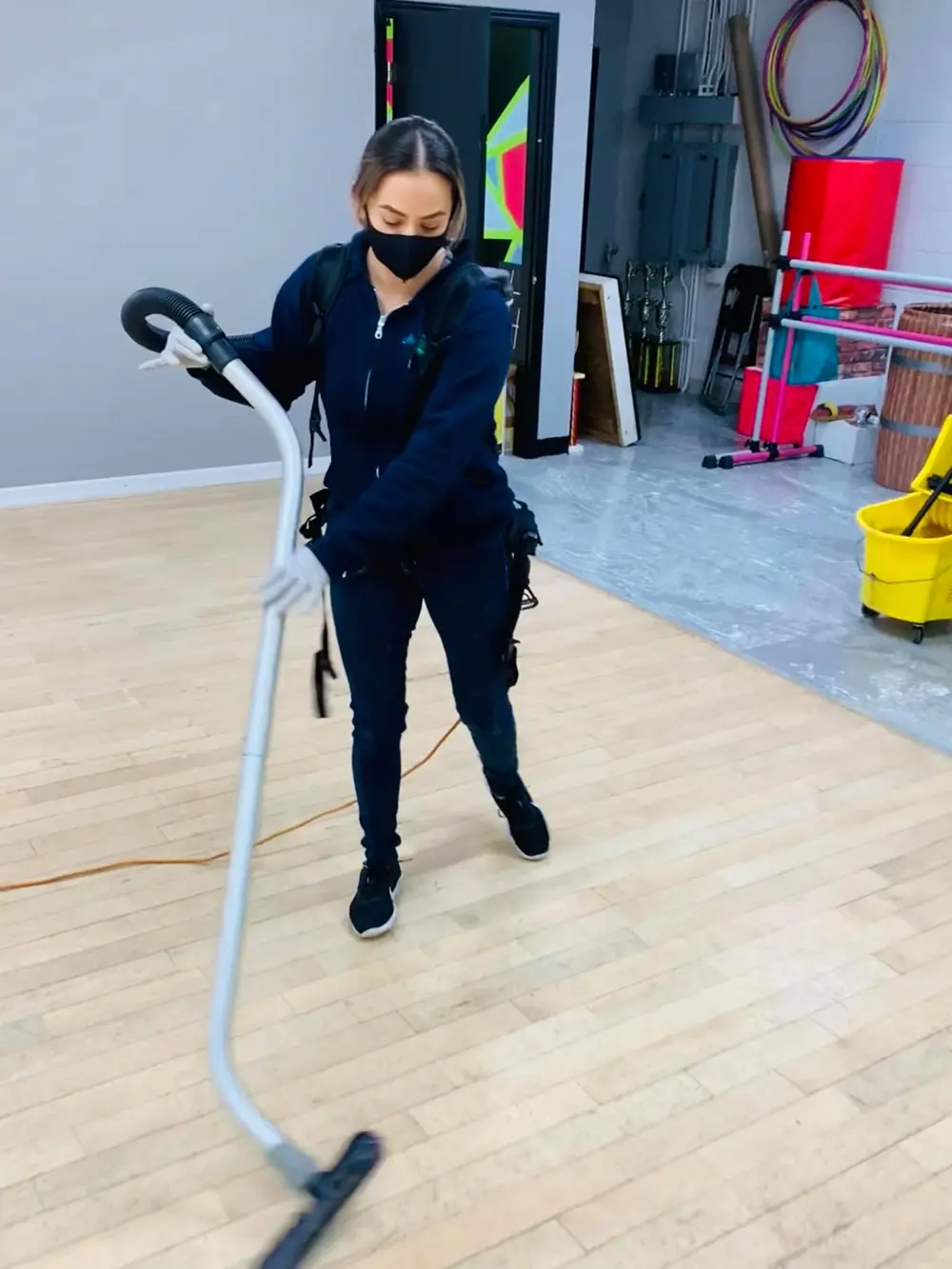
HEPA filtration is not a minor upgrade. Standard commercial vacuums filter 85–95% of captured particulate. That sounds like a high number until you calculate what 5–15% of a building’s daily dust, allergen, and biological load being exhausted back into the air means for the people breathing it. HEPA filtration captures 99.97% of particles at 0.3 microns – the size range that includes dust mite allergens, mold spores, and fine particulate matter. For employees with asthma, allergies, or any respiratory sensitivity, this difference is significant and immediate.
Microfiber removes more with less chemistry. Microfiber technology physically traps and lifts contaminants from surfaces through electrostatic attraction rather than chemical dissolution. Combined with certified green cleaning agents, microfiber systems consistently outperform traditional cotton mop-and-bucket methods for bacterial removal – while using a fraction of the chemical volume. Less product use means less residue on surfaces, less VOC off-gassing, and lower chemical exposure for occupants.
The Business Case: Four Reasons Beyond Sustainability
Eco-friendly cleaning is often framed as a values decision. It’s also a business decision with measurable outcomes.
Employee Health and Productivity Employees in buildings with low-VOC cleaning programs report fewer headaches, less eye and throat irritation, and improved daily comfort. These aren’t anecdotal – they’re consistent across facilities that make the switch. Reduced chemical exposure in a sealed building directly affects cognitive performance and afternoon energy. For a 30-person office, even a modest improvement in afternoon productivity represents meaningful output gain.
Reduced Sick Day Incidence Conventional cleaning products with VOC off-gassing contribute to the sick building syndrome conditions that drive absenteeism. Low-VOC programs, combined with HEPA filtration that removes allergens and particulate from building air, reduce the environmental factors contributing to upper respiratory complaints and allergy-driven sick days.
LEED Certification Compliance LEED v4 and v4.1 Indoor Environmental Quality credits require certified green cleaning products, HEPA-filtered equipment, written cleaning policies, and chemical usage documentation. If your building is pursuing or maintaining LEED certification, your cleaning vendor must be providing the right products and documentation – not just claiming to. We provide full compliance documentation automatically.
ESG Reporting and Corporate Sustainability For companies with environmental sustainability commitments, a documented certified green cleaning program is a concrete, reportable initiative. Chemical usage logs, product certification records, and waste reduction data from concentrated dispensing systems are the kind of documented environmental contribution that belongs in ESG reports – not just a claim that “we use green products.”
Who Benefits Most From Eco-Friendly Cleaning
Not every facility has the same driver. Here’s how the benefit profile maps to common facility types:
| Facility Type | Primary Benefit | Secondary Benefit |
|---|---|---|
| Corporate office (sealed building, NW suburbs winter) | VOC elimination – employee health and afternoon productivity | ESG documentation for sustainability reporting |
| School or daycare | Child safety – non-toxic products eliminate chemical exposure risk | Indoor air quality improvement during high-occupancy periods |
| Medical facility (immunocompromised patients) | Patient safety – low-VOC products safe for respiratory-sensitive patients | Compliance documentation for healthcare standards |
| LEED-certified building | Certification compliance – required product and documentation standards | Tenant satisfaction and occupancy appeal |
| Tech company or professional services firm | Employee experience – talent acquisition and retention signal | Brand alignment with sustainability commitments |
| Facility with known chemical sensitivity complaints | Direct symptom resolution – eliminate the source of employee complaints | Reduced absenteeism and HR management overhead |
Winter in the Northwest Suburbs: When Indoor Air Quality Matters Most
October through April in Schaumburg, Hoffman Estates, and the surrounding NW suburbs means sealed buildings, closed windows, and HVAC systems running continuously in recirculation mode. It’s the highest-risk period for indoor air quality degradation from conventional cleaning chemical off-gassing.
The math is straightforward: a building with 50 employees, sealed from October to April, cleaning 5 nights per week with conventional high-VOC products – that’s 130+ nights of chemical off-gassing being distributed through a recirculating HVAC system to every occupied desk in the building. The cumulative VOC load in the building’s air is highest by mid-winter.
Switching to low-VOC certified green cleaning products during this period delivers the clearest and fastest indoor air quality improvement. Employees in these buildings typically report noticeable improvement in daily comfort within 2–4 weeks of the switch – particularly in the elimination of morning chemical odor and afternoon headache frequency.
Transitioning to Green Cleaning: What It Looks Like
Switching from conventional to certified eco-friendly cleaning doesn’t require downtime or a learning curve for your operations. Here’s the process:
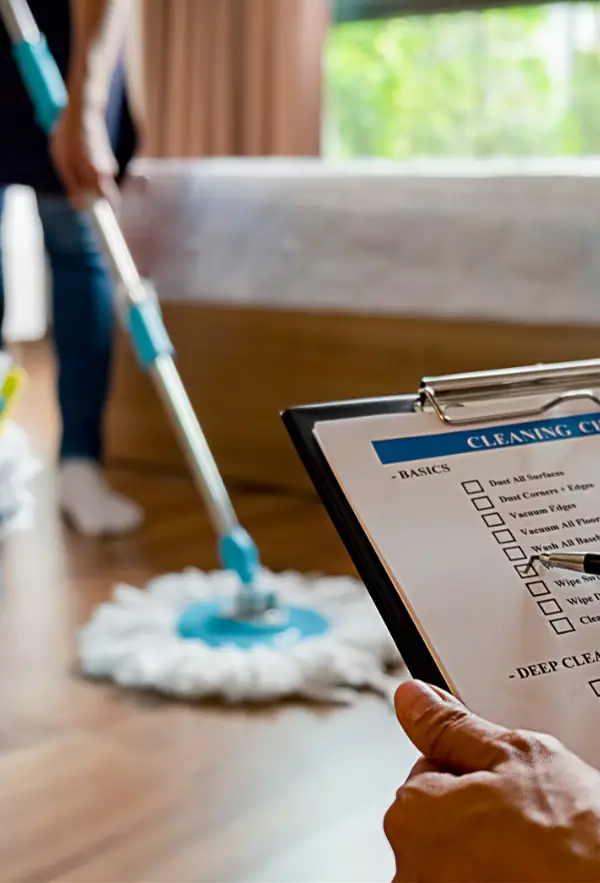
- Protocol assessment (1 session): We review your current products, equipment, and cleaning methods – identifying what can be directly replaced with certified alternatives and what requires a modified approach.
- Product transition (immediate): Green Seal and EPA Safer Choice certified products are substituted for conventional cleaning chemicals. HEPA equipment is deployed where applicable.
- Staff training (1 session): Eco-friendly products work differently – dwell times, dilution ratios, and microfiber handling require specific technique. Your crew learns the protocols before the switch.
- Documentation setup: Chemical logs, SDS records, and protocol documentation begin automatically. LEED and ESG reporting packages are available on request.
- 30-day check-in: We confirm cleaning performance matches conventional results, address any adjustment needs, and gather occupant feedback on air quality and comfort improvement.
No service disruption. No cleaning performance gap. A building that’s noticeably different to be in within the first few weeks.
The chemical smell in your building on Thursday morning is not inevitable. It’s the byproduct of conventional cleaning chemistry in a sealed environment – and it’s completely eliminable. Low-VOC certified green cleaning programs remove it entirely, along with the headaches, eye irritation, and afternoon fatigue that come with it.
Contact Amazing Cleaning Janitorial for a free eco-friendly cleaning assessment and program proposal.


What's Included
Our Process
Current Protocol Assessment
We review your facility's existing cleaning products, equipment, and protocols to identify where conventional chemicals can be replaced without compromising performance or adding cost.
Green Product and Equipment Transition
Conventional harsh chemicals are replaced with performance-matched Green Seal or EPA Safer Choice certified alternatives. HEPA vacuums and microfiber systems replace standard equipment where applicable.
Staff Training on Green Protocols
Eco-friendly cleaning requires correct application techniques–dwell times, dilution ratios, and microfiber handling differ from conventional methods. Crew training ensures performance is maintained through the transition.
Documentation and Ongoing Monitoring
Chemical usage logs, SDS sheets, and cleaning protocol records are maintained for LEED compliance, ESG reporting, or facility health documentation. Performance is monitored to ensure green products are delivering results equivalent to conventional cleaning.
Seasonal Note
NW suburb winters (Nov–Apr) mean sealed buildings and recirculated air–VOC concentration from conventional cleaning products peaks during this period. Switching to low-VOC green cleaning has the greatest indoor air quality impact during winter months.
Facilities We Serve
Service Questions
Commonly asked questions about our eco-friendly cleaning systems.
- Yes–with an important distinction. The certification process for Green Seal and EPA Safer Choice products requires demonstrated cleaning efficacy against defined pathogen and soil benchmarks. These aren't watered-down alternatives. They're commercial-grade formulations that achieve the same biological efficacy through different chemistry–plant-derived surfactants, enzymatic action, or oxidative compounds instead of harsh synthetic solvents. The performance difference most facilities notice is the absence of streaking and residue that harsh chemicals leave behind–which is actually a cleaning quality improvement, not a compromise.
- The products your facility manager tried were almost certainly not Green Seal or EPA Safer Choice certified–they were green-labeled retail products with minimal efficacy requirements. Commercial-grade certified green products are a fundamentally different category. Green Seal certification requires independent testing against ASTM and AOAC performance standards for cleaning efficacy. EPA Safer Choice certification requires that every ingredient meet strict safety criteria while maintaining commercial performance. The reason green cleaning gets a bad reputation is greenwashing–products that claim environmental friendliness without certified performance. We don't use those.
- Conventional commercial cleaning products contain VOCs (volatile organic compounds) that off-gas after application. In a sealed NW suburb office building–windows closed October through April, HVAC recirculating interior air–those VOCs distribute to every desk and workspace and concentrate over the course of the day. The symptoms: persistent headaches, eye and throat irritation, afternoon fatigue, and general malaise that employees often attribute to other causes. Low-VOC green cleaning products don't off-gas. Your HVAC recirculates clean air. Employees in buildings that switch to certified green cleaning programs consistently report noticeable improvement in daily comfort within the first 2–4 weeks. This isn't a soft benefit–it shows up in productivity and sick day data.
- LEED v4 and v4.1 Indoor Environmental Quality credits for cleaning require: (1) Cleaning products that meet Green Seal GS-37 or EPA Safer Choice standards, (2) Equipment meeting specific filtration and performance standards (HEPA filtration for vacuums, sound level requirements), (3) A written cleaning policy covering product selection criteria, dilution procedures, and disposal protocols, (4) Chemical usage logs and SDS documentation for all products used. We provide all of this automatically for LEED-pursuing clients. If your building is mid-certification process and your current cleaning vendor isn't providing compliant products and documentation, switching vendors before your IEQ credit submission is straightforward.
- In practice, not meaningfully. The raw product cost of certified green cleaners is slightly higher per unit than conventional chemicals, but our concentrated dispensing system reduces waste and actual product use significantly–the cost difference is negligible at the program level. HEPA vacuum equipment represents a one-time investment amortized across the program. Microfiber systems reduce disposable cleaning material costs over time. Most clients transitioning from conventional to eco-friendly programs don't see a material change in their cleaning invoice. If there is any difference, it's typically $50–$150/month for a mid-size facility–offset by the employee health and productivity benefits.
- Five categories see the clearest benefit. (1) Schools and daycares: children are more susceptible to chemical exposure than adults; low-VOC, non-toxic products eliminate the risk of chemical irritation or accidental exposure. (2) Medical facilities with immunocompromised patients: patients in chemotherapy, recovering from surgery, or with respiratory conditions can't tolerate harsh chemical off-gassing in waiting areas or exam rooms. (3) Sealed corporate offices in winter: VOC concentration is highest in sealed buildings; the health benefit is proportional to time spent indoors. (4) LEED-certified or pursuing buildings: certification requires it. (5) Companies with ESG commitments: documented green cleaning programs support environmental sustainability reporting.
Ready for a Spotless Workspace?
Get a free, no-obligation quote for your NW suburb facility. We respond within 24 hours.
Or call us at (847) 222-3536