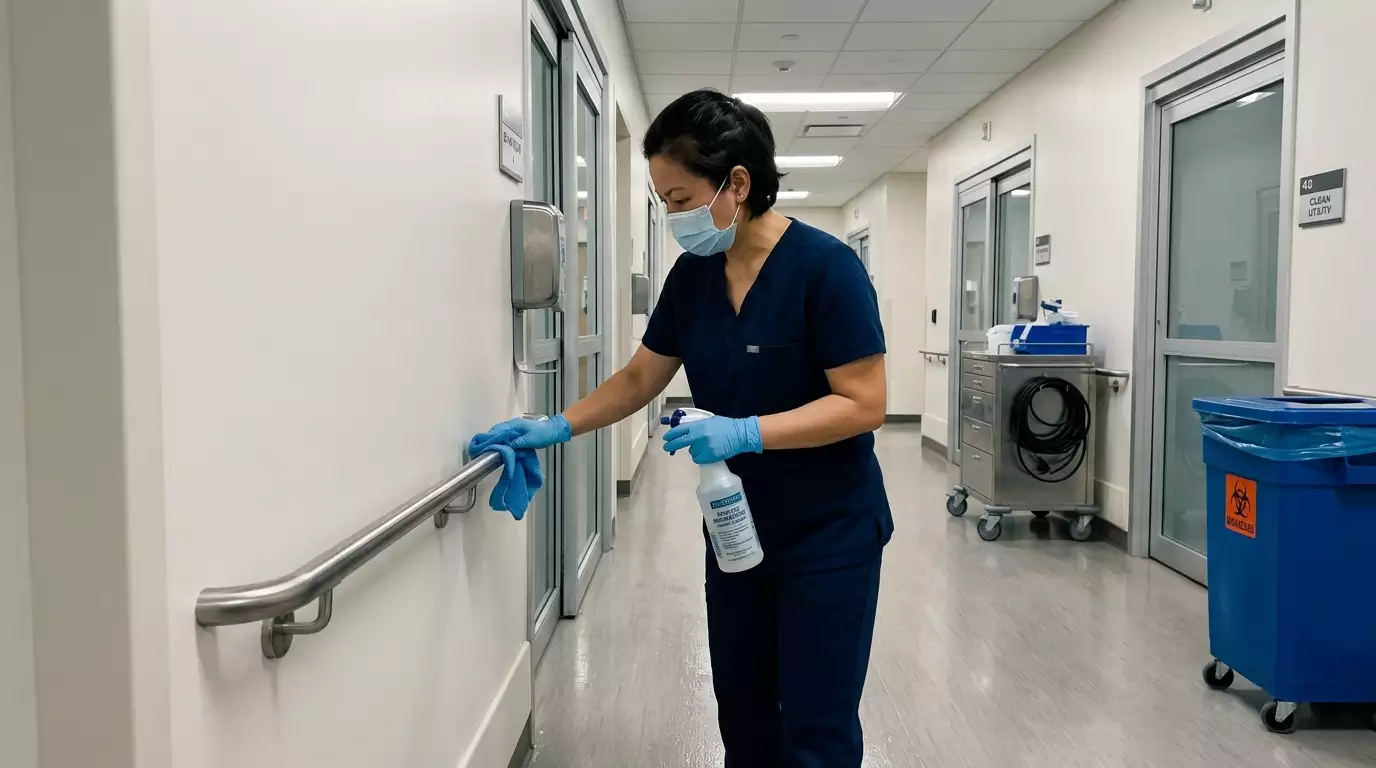
Medical-Grade Cleaning for Healthcare Facilities
OSHA-compliant, healthcare-trained cleaning that protects patient safety, prevents pathogen transmission, and ensures regulatory readiness.
In Healthcare: Trust Isn’t Built on “Looks Clean”–It’s Built on Verified Clean
The Liability Problem Nobody Talks About Until It’s Too Late
Patients sitting in your waiting room are already anxious. They’re trusting you with their health. Then they notice:
- The smudge on the exam table that’s been there since yesterday
- The soap dispenser that’s been empty for two days
- The faint smell in the hallway that your staff stopped noticing weeks ago
- A patient who came in with a non-infection concern and left with one
Trust erodes fast in a clinical setting. But the liability risk runs deeper.
Healthcare facilities across Schaumburg, Hoffman Estates, and the Northwest Suburbs depend on commercial cleaning vendors who were trained to clean offices. Not medical environments. Those vendors don’t understand the difference between a surface wipe and terminal cleaning. They don’t know what “dwell time” means. They’ve never heard of cross-contamination zoning. They use the same mop across patient rooms without proper decontamination.
That’s not just an operational problem. It’s a regulatory risk and a patient safety liability.
The Compliance Risk That Shows Up During Audits
OSHA. The CDC. Your state health department. The Joint Commission (if you’re accredited). Each agency has authority over your cleaning protocols, and each one can generate citations, corrective action requirements, or–in worst cases–temporary closures.
Here’s what typically happens: A facility manager doesn’t realize their commercial cleaning vendor isn’t OSHA Bloodborne Pathogen (BBP) certified until an auditor asks for documentation. There isn’t any. The conversation shifts from “how can we improve?” to “how do we explain this?”
Common audit findings:
- No cleaning logs or chemical documentation – auditors can’t verify that disinfection protocols were followed
- Untrained staff – cleaners without BBP certification or healthcare-specific training
- Cross-contamination gaps – same mops/tools used across patient and non-patient areas without decontamination
- Wrong disinfectants or inadequate dwell times – disinfectant applied incorrectly or not given time to work
- No verification of cleanliness – no ATP surface testing or objective proof that pathogens were actually eliminated
Each finding requires a corrective action plan. Each requires documentation of remediation. Each creates liability exposure and management overhead.
What Happens When Your Cleaning Doesn’t Meet Standards
Patient Infection Risk
Inadequate disinfection in exam rooms, procedure areas, and waiting rooms increases cross-contamination risk. Patients exposed to pathogens like MRSA, C. difficile, or flu virus may contract infections post-visit–infections that are attributable to your facility. Patient lawsuits, regulatory investigations, and reputation damage follow.
Audit Failures & Citations
An OSHA violation carries fines ($10,000–$145,000+ per violation depending on severity), mandatory corrective action plans, and follow-up inspections. Beyond the fines, the management time, documentation burden, and potential practice disruption are significant.
Patient Confidence
One patient reviews mentioning cleanliness concerns spreads across Google, Healthgrades, and Yelp. In healthcare, cleanliness perception directly impacts patient acquisition and retention. A single negative review about facility cleanliness can suppress 3–5 new patient inquiries.
Insurance & Liability Claims
If a patient contracts an infection potentially linked to facility cleanliness, your malpractice insurance investigation will examine your cleaning protocols and documentation. Inadequate cleaning documentation weakens your defense.
How Medical-Grade Cleaning Differs From Commercial Cleaning
Amazing Cleaning Janitorial deploys only healthcare-trained cleaning specialists to medical environments. Every team member assigned to your account holds current OSHA Bloodborne Pathogen certification and understands the specific protocols your facility type requires.
We understand zonal segregation. Your waiting room, exam rooms, lab, and restrooms each require distinct protocols, distinct tools, and distinct chemicals. Cross-contamination isn’t just sloppy–it violates OSHA standards. Our color-coded microfiber system physically prevents tools from moving between zones. Mop heads are single-use in high-risk areas. Decontamination happens before any tool moves to a new zone.
We use EPA-registered hospital-grade disinfectants correctly. We don’t just spray and wipe. We understand dwell times–the specific contact time required for disinfectant to neutralize pathogens. We document chemical usage, safety data sheets, and application protocols. This documentation is audit-ready.
We validate cleanliness objectively. ATP (Adenosine Triphosphate) surface testing measures biological contamination on surfaces–not just visual cleanliness. High ATP readings indicate remaining pathogens. Low readings prove disinfection worked. We test post-cleaning and provide reports. If ATP levels are unacceptable, we re-clean and re-test at no charge.
We generate compliance documentation automatically. Every visit produces: cleaning logs, chemical usage records, staff training verification, and ATP test results. When an auditor arrives, your documentation is complete and organized. Audit preparation takes hours, not weeks.
Medical Facility Types: Different Specialties, Different Cleaning Needs
| Facility Type | High-Risk Areas | Cleaning Focus | Recommended Frequency |
|---|---|---|---|
| Dental Practice | Suction hoses, hand instruments, patient chair mechanisms, operatory surfaces | Bloodborne pathogen containment, instrument area sterilization protocols | Daily terminal cleaning; turnovers between patients if high-volume |
| Physician Clinic | Exam tables, otoscope/ophthalmoscope heads, blood draw stations, restrooms | High-touch surface disinfection, waiting room pathogen reduction, equipment sanitation | Daily terminal cleaning, mid-day disinfection during flu season |
| Urgent Care | Waiting areas, intake stations, triage zones, trauma rooms | Rapid-turnover disinfection, high-volume surface coverage, respiratory pathogen containment | Daily + mid-shift deep disinfection of high-traffic areas |
| Surgical/Procedure Center | Operating rooms, prep areas, post-recovery zones, instrument trays | Sterile environment protocols, electrostatic spraying for hard-to-reach surfaces, strict cross-contamination prevention | Daily terminal cleaning; mid-day deep cleaning for multi-case days |
| Dialysis/Infusion Center | Dialysis machine exteriors, needle disposal areas, patient chairs, blood draw stations | Bloodborne pathogen management, needle safety protocols, frequent high-touch disinfection | Daily + mid-shift turnovers; aggressive during flu season |
| Physical Therapy Clinic | Treatment tables, exercise equipment, hand-contact surfaces, restrooms | Equipment sanitation, high-touch surface disinfection, odor control | Daily; increased frequency if treating immunocompromised patients |
Flu Season & Seasonal Protocols
Respiratory illness season in the Midwest (October–March) dramatically increases pathogen transmission risk in medical facilities. Your waiting room becomes ground zero for flu, RSV, and COVID exposure.
Our proactive flu-season protocols include:
- Increased waiting area disinfection – high-touch surfaces (check-in desk, door handles, seating) are disinfected 2–3 times daily instead of once
- Enhanced patient intake zone coverage – areas where symptomatic patients congregate get extra attention
- Extended dwell times on disinfectants – we allow longer contact time for broad-spectrum pathogen kill during peak season
- Electrostatic spraying – reaches angles traditional wiping can’t, wrapping disinfectant around equipment frames, chair mechanisms, and overhead fixtures
Proactive prevention avoids reactive liability. If you wait until a patient outbreak to increase disinfection, you’re already exposed. We recommend seasonal protocol increases before peak season starts (late September).
Switching to Medical-Grade Cleaning: What to Expect
Many practice managers ask: “Will switching cleaning vendors disrupt our operations?”
Here’s the process:
-
Medical compliance audit (1–2 hours): We walk your facility, assess current protocols, identify gaps against OSHA/CDC/state requirements, and document high-risk zones.
-
Custom protocol proposal (within 24 hours): Detailed cleaning plan by room type, frequencies, chemical specifications, staff training requirements, and compliance documentation approach.
-
Staff transition (1–2 weeks): We coordinate timing, introduce your new cleaning team, provide staff training on access/protocols, and conduct an introductory inspection with your practice manager.
-
First 30 days: Supervisor audits every cleaning visit. We collect ATP data, adjust protocols as needed, and ensure perfect alignment with your facility’s requirements.
-
Ongoing compliance: Monthly check-ins, quarterly compliance reviews, and annual protocol updates as regulations or your facility needs change.
No surprises. No compliance gaps.
Flu season peaks October–March. Now is the time to assess your cleaning protocols. If your current vendor isn’t providing medical-grade disinfection and compliance documentation, switching before peak season protects your patients and your practice. Spring audits are common; having documented, compliant cleaning protocols in place prevents findings.
The bottom line: Your patients trust you with their health. Medical-grade cleaning isn’t a nice-to-have–it’s a regulatory requirement and a patient safety imperative.
Contact Amazing Cleaning Janitorial for a free medical facility compliance audit. We’ll assess your current protocols and provide a detailed plan to ensure audit readiness.
What's Included
Our Process
Medical Compliance Audit
We assess your clinic's layout, patient flow, high-risk zones, and current cleaning protocols. We identify gaps against OSHA, CDC, and state health department requirements.
Customized Medical Protocol
A facility-specific cleaning plan is developed covering exam rooms, labs, waiting areas, and restrooms–each with distinct tools, chemicals, and frequencies based on pathogen risk.
Trained Healthcare Cleaning Team
Only staff with medical facility experience and current BBP certification are assigned to your account. Your team learns your layout, equipment sensitivities, and compliance requirements.
Documented Compliance & Validation
Every visit is logged with chemical usage, safety data sheets, and ATP testing results. Documentation is organized for regulatory audits and risk management reviews.
Seasonal Note
Flu and respiratory illness seasons (Oct–Mar) in the Midwest demand heightened disinfection protocols–especially in waiting areas, patient intake zones, and shared equipment. We increase frequency proactively during peak season.
Facilities We Serve
Service Questions
Commonly asked questions about our medical facility cleaning systems.
- Significant. Commercial cleaners trained for offices don't understand medical-specific concepts: dwell times (how long disinfectant must sit to kill pathogens), cross-contamination zoning, terminal cleaning protocols, or bloodborne pathogen safety. They may wipe surfaces quickly without letting disinfectant work, or they may use the same mop across patient rooms without decontamination. During an OSHA audit, if your cleaning logs don't document proper protocols, you face citations and liability. More immediately, inadequate disinfection increases patient infection risk–a liability that far exceeds cleaning cost.
- Most of the audit process is documentation. We provide: (1) Chemical usage logs with dwell times, (2) Safety Data Sheets for all products, (3) Staff training records and BBP certifications, (4) ATP surface testing reports showing objective cleanliness, (5) Cleaning schedules by room type and frequency. When an auditor arrives, your facility can show proof that cleaning protocols meet or exceed regulatory standards. Many practices find that switching to medical-grade cleaning resolves audit findings from their previous vendor.
- A wipe is daily maintenance–quick surface contact to remove visible dust/debris. Terminal cleaning is the deep decontamination required after patient contact in exam rooms, procedure areas, and high-touch zones. Terminal cleaning includes: disinfectant application, proper dwell time (usually 10 minutes), contact with all surfaces (including under furniture), and sometimes electrostatic spraying for equipment. Both are required. Daily wiping between patients prevents obvious contamination. Terminal cleaning at end-of-day ensures all pathogens are neutralized. Our protocol covers both.
- At minimum: terminal cleaning at end-of-day, every single day. High-volume clinics may need mid-day deep cleaning of exam rooms or turnovers between patients (common in dental practices). During flu season (Oct–Mar), most medical practices increase disinfection frequency–adding a mid-morning pass or extending dwell times on high-touch surfaces. We recommend the right frequency during your assessment based on your patient volume and specialty.
- Yes. Each has distinct cleaning requirements. Dental: focus on suction hoses, instrument sterilization areas, and patient chair mechanisms. Urgent care: high-volume waiting room disinfection, trauma room protocols, and rapid turnovers. Dialysis: machine sanitation, needle disposal, and bloodborne pathogen containment. Physical therapy: equipment sanitation and high-touch surface management. We customize protocols for your specialty during the compliance audit.
- This is built into our accountability. If ATP testing (objective biological cleanliness measurement) shows surfaces above acceptable levels after cleaning, we return the same day at no charge to re-clean and re-test. You're not paying for cleaning that isn't verified clean. Most practices appreciate the accountability–it removes guesswork about whether disinfection actually happened.
Ready for a Spotless Workspace?
Get a free, no-obligation quote for your NW suburb facility. We respond within 24 hours.
Or call us at (847) 222-3536