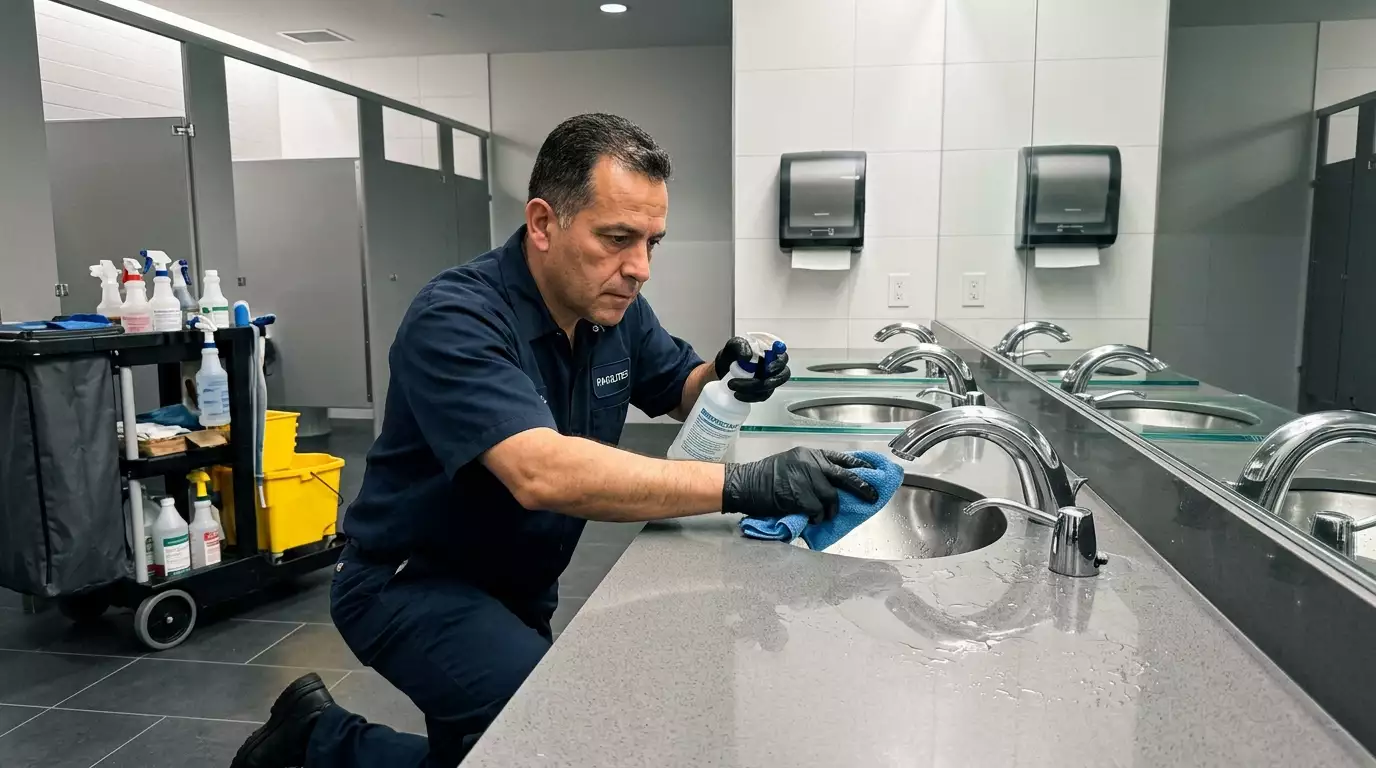
Commercial Restroom Sanitation That Eliminates Odor at the Source
Deep extraction, enzymatic neutralization, and fixture restoration–because your restrooms affect your reviews, your tenants, and your reputation more than any other room in the building.
If Your Restrooms Smell, Nothing Else You’ve Done Today Matters.
The Last Impression Problem
A client visits your office. The meeting goes well. The pitch lands. They stand up, shake hands, and use the restroom before heading out.
That’s the last impression they take with them.
If your restroom has a persistent odor – the kind that hangs in the air even after nightly cleaning – it communicates one thing clearly: the people running this building aren’t managing it properly.
It’s not fair. You’re paying for daily janitorial service. The toilets get scrubbed. The floors get mopped. The dispensers get restocked. But the smell doesn’t go away. It’s there Monday morning. It’s there after cleaning on Tuesday. By Friday it’s worse.
The reason: your janitorial service is maintaining a problem it was never designed to fix.
What’s Actually Causing That Smell (And Why Daily Cleaning Makes It Worse)
The source of persistent commercial restroom odor is almost always the same thing: uric acid crystals.
They’re invisible, odorless when dry, and completely impossible to remove with a standard mop and cleaning solution. But the moment moisture contacts them – from a mop pass, from condensation, from normal foot traffic – they activate and release the unmistakable ammonia compound that signals “this restroom isn’t actually clean.”
They live in porous grout lines. They accumulate at the base of urinals and toilet fixtures where mop heads can’t reach. They embed in the microscopic gaps in tile and the caulk bead at the base of stall partitions. They collect around floor drains.
Here’s the critical problem: every time your nightly crew mops the restroom floor, they’re activating those uric acid crystals, redistributing them across the floor surface, and pressing them deeper into the grout substrate. The odor returns faster after each cleaning. Over weeks and months, the biological load increases. The smell gets worse.
More frequent mopping doesn’t fix this. Better-smelling cleaning products don’t fix this. Air fresheners absolutely don’t fix this – they mask it for 20 minutes and leave.
The fix is extraction and enzymatic neutralization. Remove the source. Don’t cover it.
The Real Business Consequences of a Dirty Restroom
Most facility managers think about restroom cleanliness as a comfort issue. It’s actually a business issue.
Online Reviews Restroom cleanliness is consistently one of the top two factors mentioned in negative reviews for gyms, retail stores, restaurants, and office buildings. A one-star review that says “the bathrooms were disgusting” isn’t just losing you one customer – it’s suppressing every future customer who reads that review before deciding whether to visit. In the NW suburbs’ competitive commercial market, that review outlives any single sales effort you’ve made.
Tenant Retention In multi-tenant commercial buildings, restroom condition is almost always in the top three tenant complaints. It shows up in lease renewal conversations. A property manager with persistent restroom odor complaints is fighting an uphill battle at renewal time – tenants don’t separate “the restrooms smell” from “this building is poorly managed.”
Employee Morale and Productivity Employees who work in buildings with consistently poor restroom hygiene report lower job satisfaction and a perception that management doesn’t value their comfort. It’s a small signal with an outsized effect on how people feel about where they work.
Illness Transmission Restroom touchpoints – door handles, flush handles, faucet handles, soap dispensers – are the highest-contact surfaces in any commercial building. During cold and flu season (Oct–Mar), inadequate disinfection of these surfaces directly contributes to illness transmission rates. A restroom with a 100-person daily usage rate and inadequate touchpoint disinfection is a pathogen distribution system.
What Commercial Restroom Sanitation Actually Addresses
Daily janitorial maintains the surface. Professional restroom sanitation addresses the substrate.
Uric acid and grout extraction: High-pressure extraction equipment blasts embedded uric acid, bacteria, and biological soils loose from grout lines and tile surfaces – then immediately vacuums up the contaminated slurry. The source of the odor is removed, not redistributed. This is the step that actually eliminates the smell.
Enzymatic neutralization: Enzymatic bio-cleaners are applied to porous surfaces after extraction. These enzymes digest the bacteria living in the substrate at a biological level. Not fragrance masking. Not surface disinfection. Actual elimination of the organism causing the problem.
Fixture descaling: Toilets, urinals, sinks, and drains accumulate uric acid and mineral deposits in areas daily cleaning never contacts – under toilet rims, at the base of urinal traps, in drain housings. Hospital-grade descaling solutions dissolve this buildup completely. The fixtures don’t just look clean – they test clean.
Electrostatic disinfection: A fine mist of EPA-registered disinfectant wraps 360 degrees around every surface – stall partitions, touchpoints, wall tile, under-fixture areas. Reaches angles that wiping and spraying physically can’t cover.
Grout sealing: After extraction and neutralization, a professional sealant is applied to grout surfaces. This reduces porosity – bacteria and uric acid have significantly less penetration surface on sealed grout than unsealed. The restroom stays cleaner longer between service visits.
Drain maintenance: Enzymatic drain treatments prevent drain odor between deep sanitation visits by breaking down organic material before it accumulates in the trap.
How Often Does a Commercial Restroom Need Deep Sanitation?
| Facility Type | Recommended Frequency | Why |
|---|---|---|
| Gym or fitness center | Monthly | Sweat, high humidity, and heavy biological load accelerate contamination |
| High-traffic retail or restaurant | Monthly | Volume overwhelms daily maintenance quickly |
| Medical clinic or healthcare | Monthly minimum | Compliance and infection control requirements |
| Multi-tenant office building (100+ occupants) | Quarterly | Sufficient traffic to accumulate biological load between visits |
| Corporate office (under 100 employees) | Quarterly to bi-annually | Lower volume; quarterly if nightly cleaning shows diminishing returns |
| School or educational facility | Quarterly (term-based) | High volume during occupancy; deep sanitation between terms |
The practical test: if your restrooms develop noticeable odor within 48 hours of nightly cleaning, your deep sanitation frequency is insufficient. If they maintain a neutral odor for 3–5 days post-cleaning, your program is working.
Daily Maintenance vs. Deep Sanitation: Both Are Required
These aren’t alternatives – they’re layers.
Daily janitorial (nightly or day porter) maintains surface hygiene: wiping fixtures, mopping floors, restocking consumables, removing trash. Essential. Without it, restrooms deteriorate within hours.
Deep sanitation (quarterly, monthly, or as needed) addresses the biological substrate: extraction, enzymatic neutralization, descaling, sealing. Without it, daily maintenance becomes a losing battle against accumulating contamination.
Buildings that run both programs maintain genuinely clean restrooms. Buildings that run only daily maintenance are cleaning the surface of an increasingly contaminated substrate – which is why the smell never fully goes away no matter how often they clean.
Flu Season: Restroom Touchpoint Disinfection
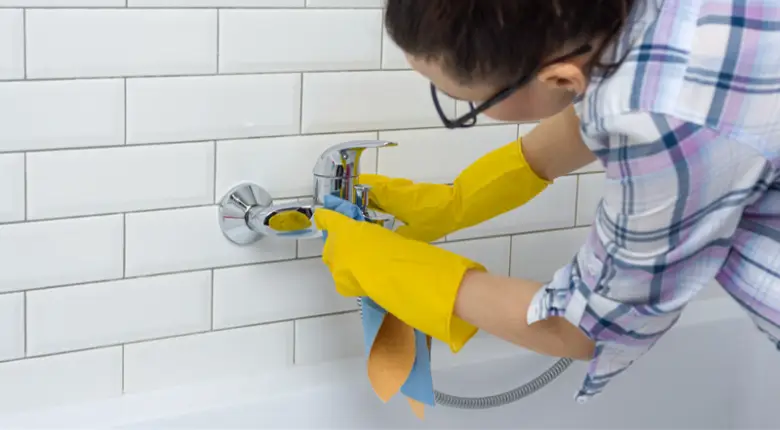
October through March in the NW suburbs is peak respiratory illness season. Your commercial restroom’s high-touch surfaces – door handles (inside and outside), flush handles, faucet handles, soap dispenser pushes, paper towel dispensers – are touched by every single occupant, multiple times per day.
Standard nightly disinfection is a single pass. During flu season, that’s insufficient for facilities with 50+ daily users.
Our flu season restroom protocol adds:
- Increased touchpoint disinfection frequency – mid-day disinfection pass on all handles and high-touch surfaces
- Extended disinfectant dwell times – allowing full contact time for EPA-registered disinfectants to kill influenza and respiratory virus strains
- Increased restocking checks – soap dispensers that run empty during peak illness season become an immediate hygiene gap
- Drain treatment – enzymatic treatments prevent drain bacteria accumulation during the higher-humidity winter period
Proactive flu season protocols reduce illness transmission rates – which shows up in your absenteeism data within weeks.
The smell in your restroom has a specific source. It’s not the building’s age, your cleaning vendor’s effort, or bad luck. It’s biological accumulation in a specific location that daily maintenance was never designed to address. We find it. We extract it. We eliminate it.
Contact Amazing Cleaning Janitorial for a free restroom audit and deep sanitation quote.

What's Included
Our Process
Restroom Odor and Bacteria Audit
We identify the actual source of persistent odors–grout lines, drain bases, fixture undercuts, partition caulk–not just the symptom. Most restroom odor problems have a specific location that daily cleaning never reaches.
Deep Extraction
High-pressure extraction removes embedded uric acid, bacteria, and biological soils from tile, grout, and around fixture bases. The contamination is removed–not redistributed by mopping.
Enzymatic Neutralization and Disinfection
Enzymatic bio-cleaners digest the bacteria living in porous substrates. EPA-registered hospital-grade disinfectants treat all surfaces, touchpoints, and stall interiors. The result is biological cleanliness, not fragrance masking.
Protective Sealing and Ongoing Prevention
Grout sealant reduces porosity and slows future bacterial colonization. Enzymatic drain treatments prevent drain odor recurrence between deep service visits.
Seasonal Note
Cold and flu season (Oct–Mar) demands heightened restroom touchpoint disinfection–door handles, flush handles, faucets, and soap dispensers are primary illness transmission vectors. We increase disinfection frequency and dwell times during peak illness season.
Facilities We Serve
Service Questions
Commonly asked questions about our restroom sanitation systems.
- Because mopping doesn't fix the odor problem–it spreads it. The source of persistent restroom odor is uric acid crystals: invisible, odorless when dry, but activated by moisture to release ammonia compounds. They embed in porous grout lines, accumulate at the base of urinals, and settle into fixture undercuts and partition caulk. When you mop, you're activating those crystals, redistributing them across the floor, and pressing them deeper into the substrate. The smell gets slightly worse with every pass. The fix isn't more frequent mopping–it's professional extraction and enzymatic neutralization that removes the source entirely.
- Your nightly crew handles surface maintenance: wiping fixtures, mopping floors, restocking dispensers, emptying trash. That's essential for daily hygiene but it doesn't address the biological layer underneath. Restroom sanitation goes deeper: high-pressure grout extraction pulls embedded contamination that mopping can't reach, enzymatic cleaners digest bacteria in porous tile and grout, fixture descaling removes uric acid and mineral buildup from areas daily cleaning never contacts, and grout sealing reduces future penetration. Think of it like the difference between washing your car and detailing it–one maintains appearance, the other addresses the substrate.
- It depends on traffic volume and restroom type. High-traffic retail or gym restrooms: monthly. Corporate office restrooms (50–200 employees): quarterly. Low-traffic professional offices: bi-annually. Medical or food-adjacent facilities: monthly minimum. As a rule: if your restrooms develop a noticeable odor within 48 hours of nightly cleaning, you need more frequent deep sanitation. If they maintain a neutral odor for 3–5 days post-cleaning, your current frequency is working. We assess this during your restroom audit and recommend the right interval.
- In most cases it's not structural–it's biological accumulation in a specific location that's never been properly extracted. The most common culprits: (1) The floor drain and its immediate surround, where uric acid and bacteria accumulate heavily and drain cleaning is rarely included in nightly routines. (2) The grout lines along the urinal wall and floor junction, where uric acid crystals have built up over years of daily mopping redistribution. (3) The caulk bead at the base of stall partitions and around toilet bases, which absorbs biological material and holds it. We identify the specific source during the audit and address it directly. Most 'unfixable' restroom odors are resolved after the first deep sanitation.
- Multi-tenant building restrooms fail for two reasons: insufficient daily service frequency and no periodic deep sanitation. The fix is both. For the daily layer: restrooms in a multi-tenant building with 100+ occupants need multiple service passes per day–not just overnight cleaning. A day porter handling mid-day restocking and surface wipe-downs makes a significant difference. For the deep layer: quarterly or monthly deep sanitation eliminates the biological buildup that makes daily cleaning feel futile. We can scope both–daily service coordination and periodic deep sanitation–as a combined program. Tenant satisfaction on restroom cleanliness typically improves within the first 30 days.
- Yes–and this is more direct than it sounds. Restroom cleanliness is one of the top factors cited in negative reviews for offices, gyms, retail stores, and restaurants. A single review mentioning 'disgusting bathrooms' suppresses new customer visits and drags your overall rating. The same review, if it appears frequently, signals a systemic problem to every potential customer reading it. Professional restroom sanitation–combined with a day porter for mid-day maintenance in high-traffic facilities–directly addresses the condition that's generating those reviews. Most facilities see a shift in restroom-related review sentiment within 60–90 days of implementing a proper sanitation program.
Ready for a Spotless Workspace?
Get a free, no-obligation quote for your NW suburb facility. We respond within 24 hours.
Or call us at (847) 222-3536